The Ledges, Deschutes River, 1982
Up with that damned alarm next morning. The only light I can see comes from the kitchen, where the redoubtable Kohn is getting breakfast and coffee going before we rouse the troops. I press the heels of my palms into my eye sockets and take a deep breath, then slip into shorts and sneakers, toss on a hoody and grab my headlamp. Danish, sliced cantaloupe and honey dew melon wait on the table. A huge pot of black coffee simmers on the Coleman.
Half an hour later, I lug my dry bag and lounger to the bank alongside the raft, the way Kohn likes it. I slip into my waders, then find Gordy and confirm the day’s plan. I hear voices out on the water and in the light of the lantern we make out Mike standing knee deep in the river, holding the rail of my boat with one hand and sipping his coffee with the other. Kenny and Don are in the front seats. Gordy snorts.
I walk down to the bank and break into a grin. “You’re waiting on me, correct?” They laugh. “Hang on.” I pick my vest off a nail in a tree and walk over to get my rod. I swear, sometimes you couldn’t pry your guys out of the sack with a stick, other times they came to fish. As I climb aboard and settle in at the row station Gordy calls out: “Good luck.”
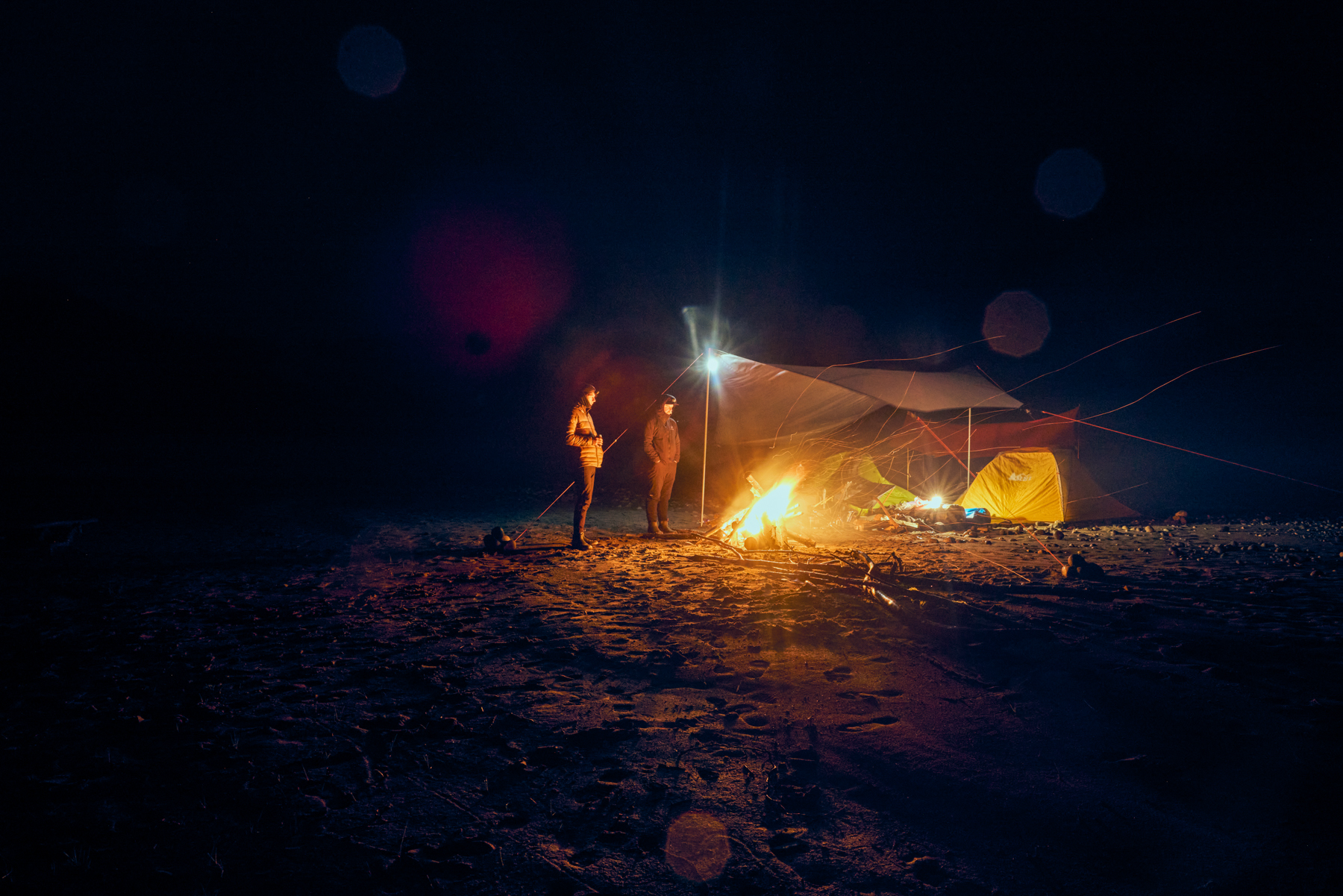
“We’ll nail a camp in Kloan if possible,” I call back, “No need to have Kohn bust a nut. Either it’s vacant, someone’s there and packing up or there and staying put. We should be rolling just in time to lay claim if it’s vacant.” Gordy nods. “If Sumac isn’t open, then either the little spot up by the bridge or if you think we can fit, down at Cabin.”
I nod. “Kohn deserves some fishing time; he’s been on it like glue the entire trip. We’ll be there well ahead of him, in any case, so he needn’t hurry.” Mike pulls the boat clear of the boney shallows and climbs aboard. I wag the oars a couple of times then draw half blades until we clear the rocks and the current takes us.
With the coffee, the excitement fills me again: We are on the water chasing after the prince of fishes at break of day in a gorgeous, desert canyon. We ferry mid-channel and shoot the chute, bucking the standing waves like we’re riding a bronco. As we pass the big sled camp, we see lanterns flickering in the trees and one fellow down by the boats; we wave in silence.
The boat is quiet, voices subdued. Only the soft plash of oars mars the silence as I keep the boat to center channel and sip my coffee. It is tempting to stop and fish yesterday’s water, but we hug the far bank and sweep along the narrow channel below the LOCKIT sign up alongside the tracks. Kenny turns to me: “So what’s the drill, boss?”
“As you heard, we’re the gunner to nail camp in Kloan, but no great rush there. What I’m thinking is to put a couple of you guys ashore on the east bank, a little ways down.” Don says: “I remember Kloan, had a memorable evening there.”
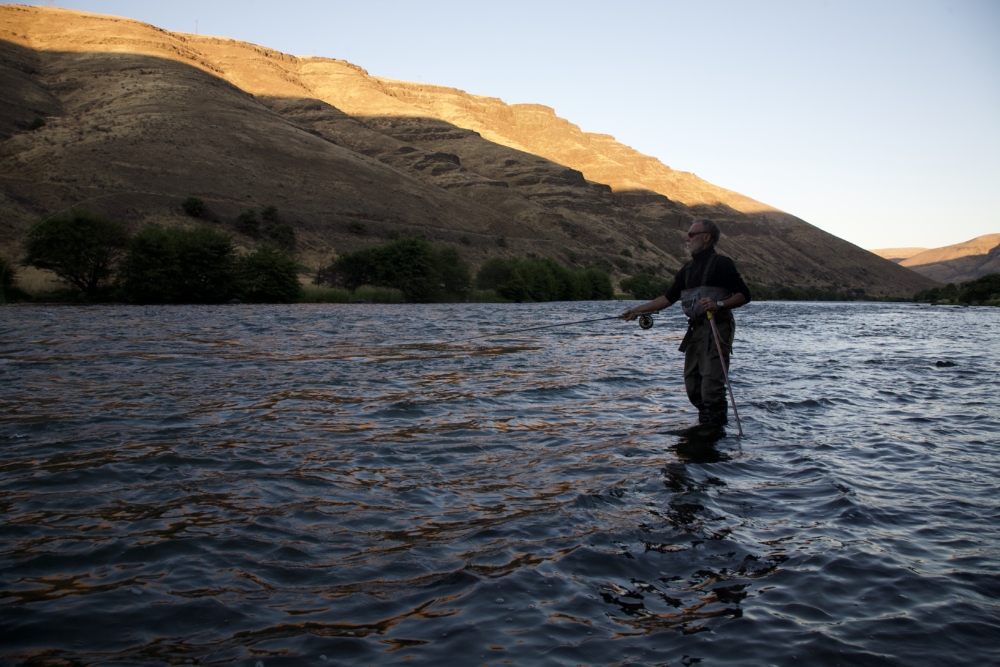
“Classic water,” I say. “Who fished The Ledges with me last year?” “I did.” Don again. “And who wants to try it this morning?” Mike and Ken paper, scissored, rocked and Ken won out. While I refer to them as ledges, a small, underwater mesa might be the more apt description. Geologically speaking, they are a horizontal extrusion of columnar basalt, as found elsewhere in the canyon. What’s so extraordinary, apart from standing in the middle of the river, is sight casting to fish laying in troughs, or bathtub-size impressions of missing basalt columns.
The first blush of light on the eastern horizon affords us a view of the immense rock wall at Harris Canyon, a mile down river. We have just enough light to fish, but as we draw closer, we see a tent and a light. “Nix on Harris then, we’ll just have to drop down a bit further.” I smile, recalling the incident several years past. “Did I ever tell you guys how Pick Pocket got its name?”
Laughing, I tell how a buddy and I had hiked upriver to fish a particular run back in Lockit and found a drift boat pulled ashore and two men asleep nearby. We felt bad about the intended larceny but the underlying maxim on the river is snooze and lose. We kept the faith that morning and woke them up with our reels giving full throat to no less than three steelhead!
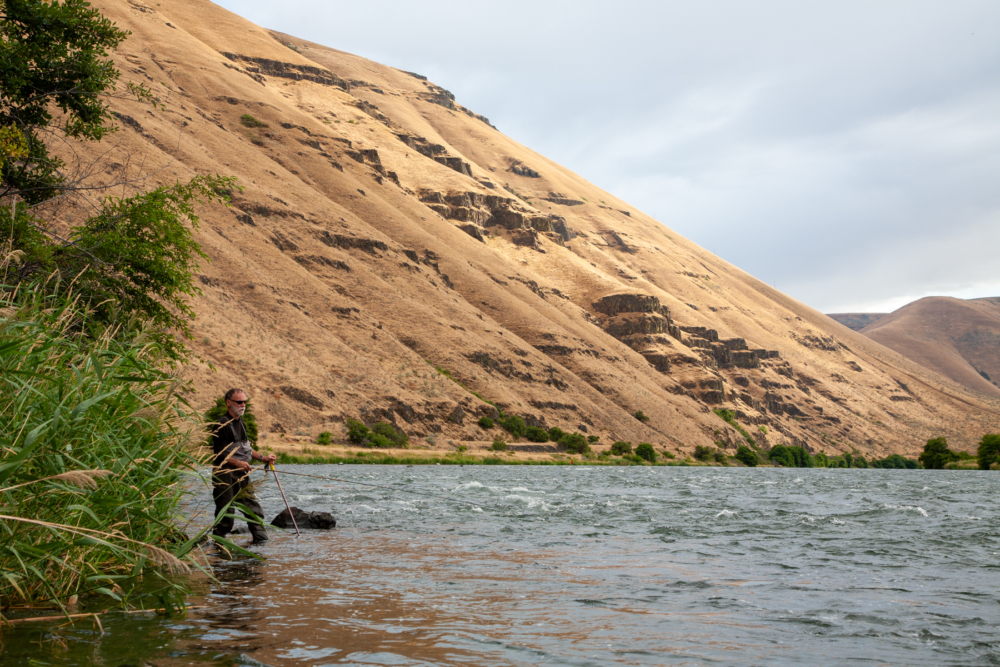
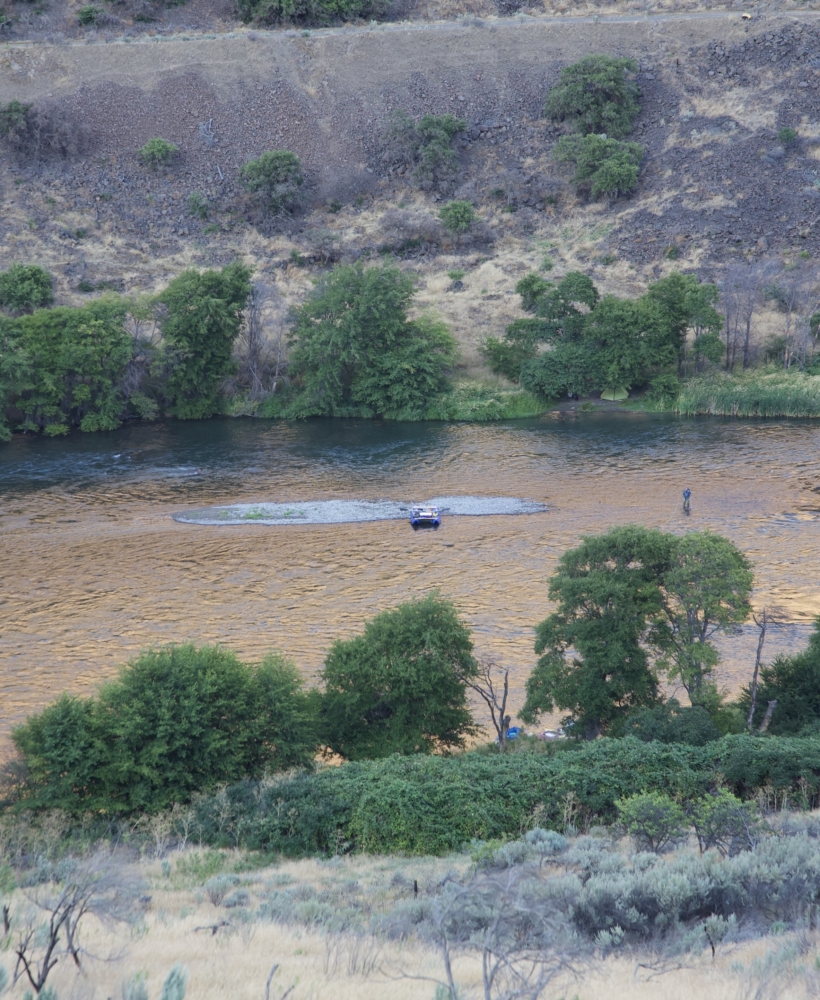
The boys had brought a big Thermos along, courtesy of Kohn. Talk had livened, voices raised with the first blush of light. Humming along at the oars behind them I think how like a sports car these dories are. When I started out, I had Kohn’s job and ran the barge—that needs at least two strokes on the oars to register a response!
At Corchy’s, I give Mike and Don a quick briefing. “When you finish here, hike down to Machinery, just around that corner.” I point down river. “Long, obvious run. Mike nods, “I remember it.”
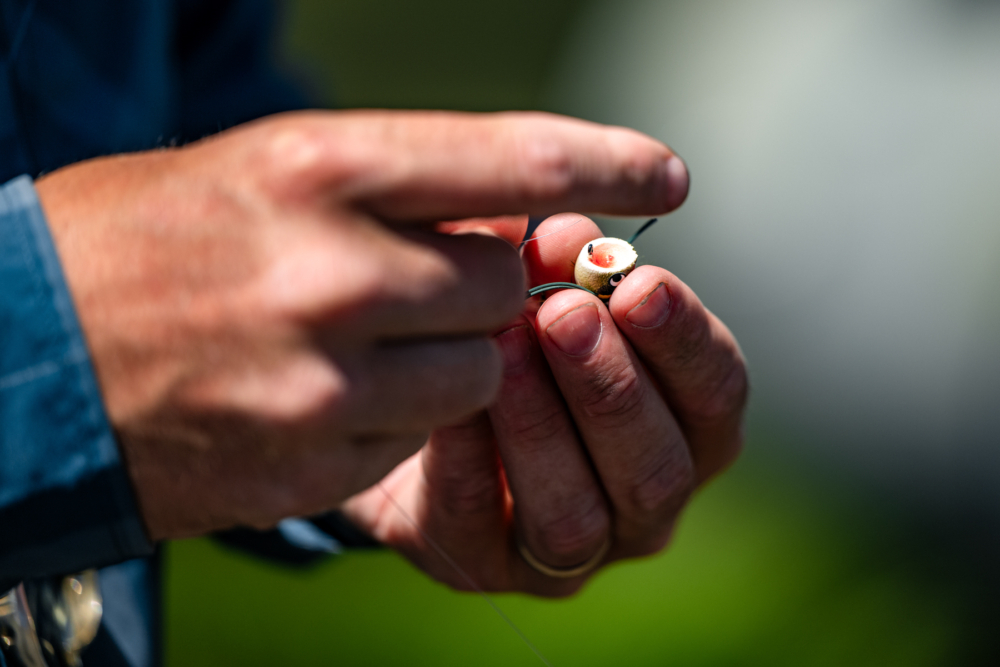
“Good, we’ll meet up with you there.” They push us off while I take a nasty, black stonefly nymph the size of my finger from my fly book and give it to Ken. “Tie this bad boy on.”
A broad, spacious flat with grazing cattle opens to our left at Burn Canyon. We see a truck leading a phalanx of dust a mile off, a rancher no doubt, the road is private. I explain the situation to Ken as I scope the water ahead, looking for the tell-tale dimples and swirls marking a shelf of shallow basalt columns over an area the size of a basketball court. The river widens, flowing smooth and steady. I spot it, finally, and ferry river right. I tell Ken to stand beside me and be ready to step out and hold the boat. He picks up his rod and vest.
“Leave it,” I tell him, “I’ll hand it to you.” He looks tentatively down at the water, cupping his hands over the brim of his cap to try and make out the bottom. I make two shallow pulls and ship the oars. “Okay . . . now.” He slips overboard, finds his footing and holds tight to the boat. I wedge the anchor, snugging it into a crevice and wetting my bare arm to the shoulder, then yank on it several times to be sure. “We’ll want to take it quiet and not tap too loudly with our staffs,” I held up mine, a metal ski pole; Ken holds up wood, good. “I’ll lead the way.”
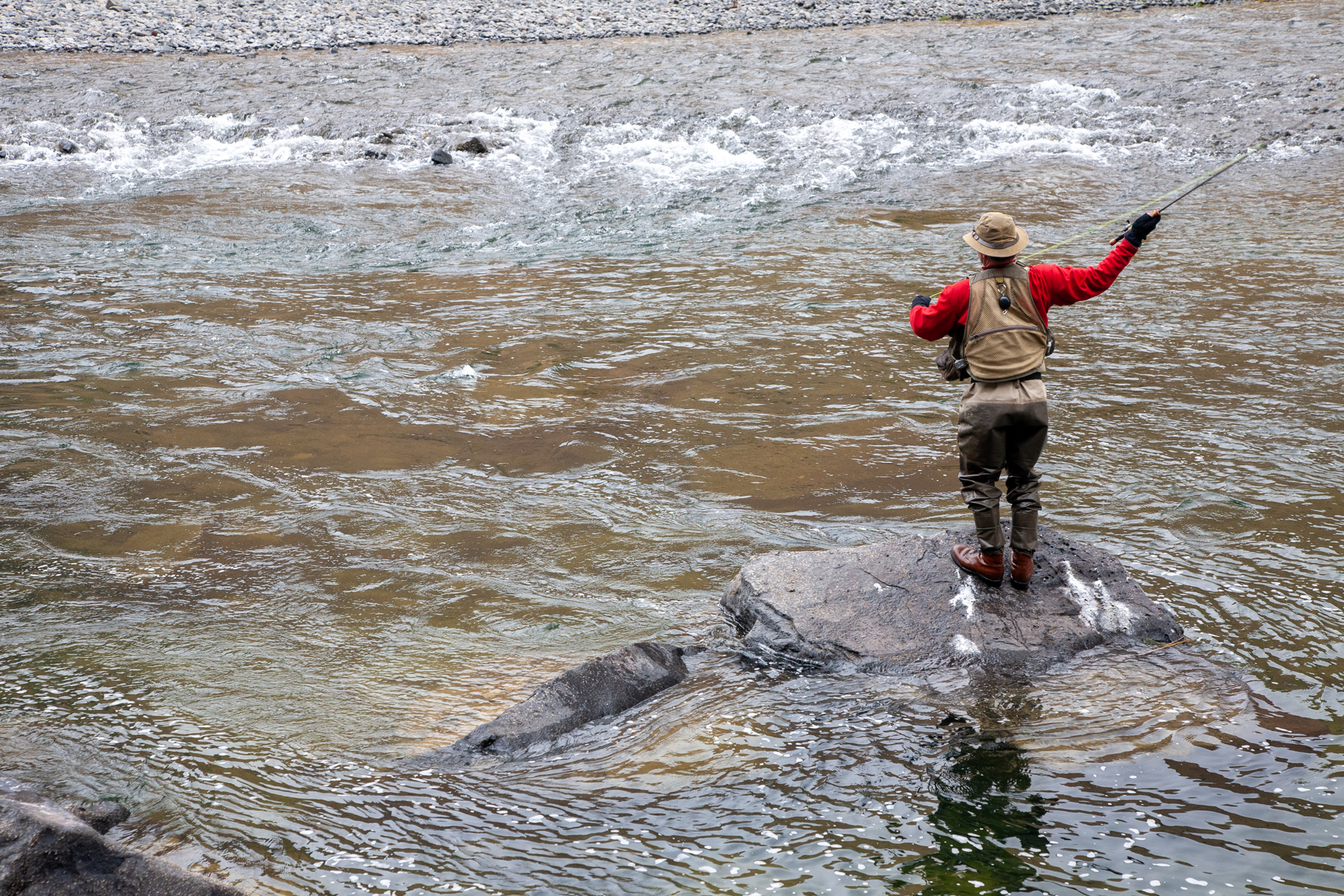
We wade together across the ledge together, Ken holding onto my wading belt and following closely in my footsteps. The footing is slick, even with felt-soled wading boots. A foot of brisk water boils around our ankles, obscuring our vision. Finally, I can just make out the trough at the upriver edge of the shelf and stop. “Hang here a sec.” Wading carefully closer I see it—a smooth slick of water demarcating the depression and a muted, glint of silver. Steelhead, judging by the color. Suckers and carp hang there, too, but they flash a dirty gold.
I call back to Ken: “Somebody home, alright. Dead drift right down the throat, right about there,” and I point. “That’s the money cast; can you make out the trough?” He angles his head a couple of times, cups his hands over his glasses, then points. “There, right?”
“Right. You’ll want to make it clean, don’t line it. Like sight fishing with a forward scout. I’ll signal if he takes.” Ken worked out line to lay out a nice reach cast, leaving the fly line neatly this side of the trough, but the fly fell short. “This time . . .” I could hear him mutter. Indeed, next cast was net. I cupped my hands tightly over the bill of my hat and waited a couple of seconds, then another, then sure enough, a silver wink. “Now!”
A tight boil appeared as a fish shot up and over the ledge in a foot of water, passing right in front of me! I ducked and Ken raised the rod, the fly line scraping over my back. I watched a shark-like wake speed across the ledge and into deeper water, while out of the corner of my eye I saw the water hump and travel quickly upriver where another fish had spooked.
Ken waded back quickly toward the boat. He would have to clear the line in case the fish swam upriver around the anchor line. He slipped once and went down to his knees but kept the rod held high. He stood just off the stern of the boat, rod bent deeply and pointing nearly straight down to river bottom. Leaning back hard on the rod, the fish began to rise ever so slightly before thinking better of it and scooting out to mid-channel and leaping head over tail in the early morning light.
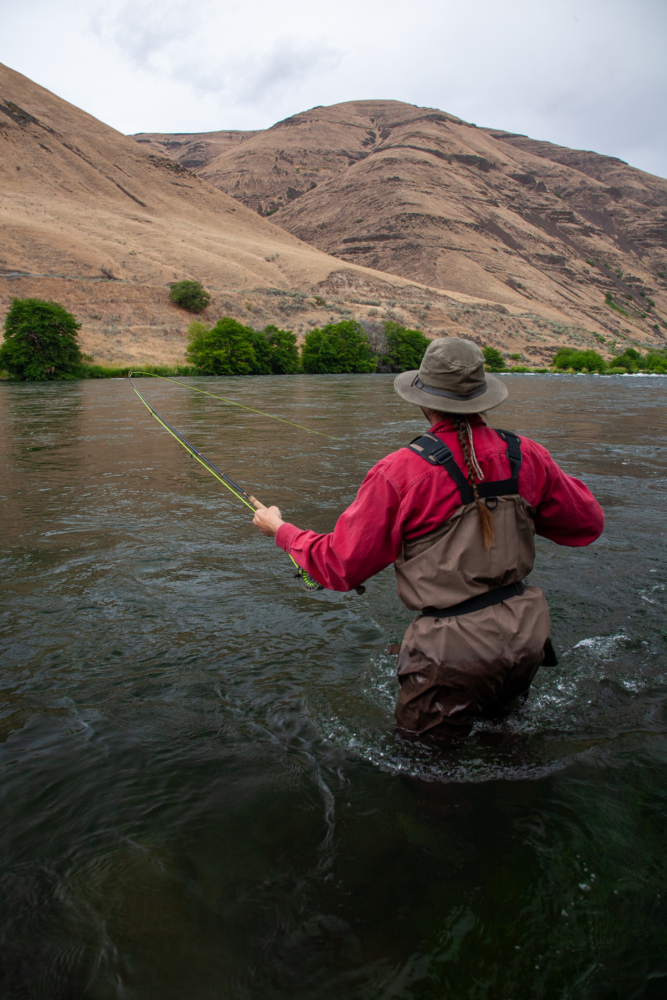
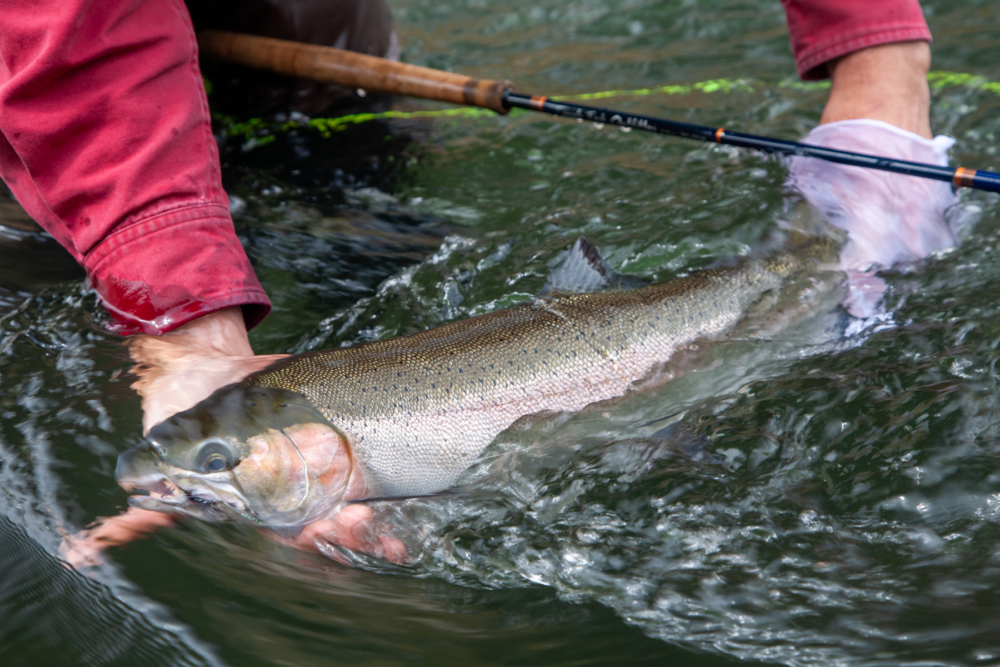
Before long the fish tired and returned to the base of the ledge, where Ken worked it smoothly to surface. I put on my tailing glove. Ken lifted just the head of the fish out of the water and swung it toward me. And as it passed by I shot out my hand and had it by the tail, a consummate closure. I cradled it just beneath the river’s surface while it breathed, gills rhythmically opening and closing. It was mint bright, pug nosed, about eight pounds, an absolute poster fish for the Deschutes. We heard a hoot and glanced up to see the boys up on the grade looking our way, smiling, laughing, fists in air!
Ken was beaming, I was too. We must look a sight, standing mid-river, nearly walking on water. Any fish holding in the other troughs would have flown the coop, alerted by Ken’s fish. Fishing the trough like we did had always been a one-off, but an equally promising lie lay at the far edge in a narrow channel between the shelf and shore.
A second pass under the alder branches sweeping the river surface and it was fish on! We trailed along behind as it headed for mid-channel, where a passing jet boat had slowed to watch the action. I felt strangely exposed standing in the middle of the river like we were and gave only a perfunctory nod to the captain. They motored upriver before Ken brought this second fish to my hand. Another bright, pug-nosed beauty, and that was it for the ledges.
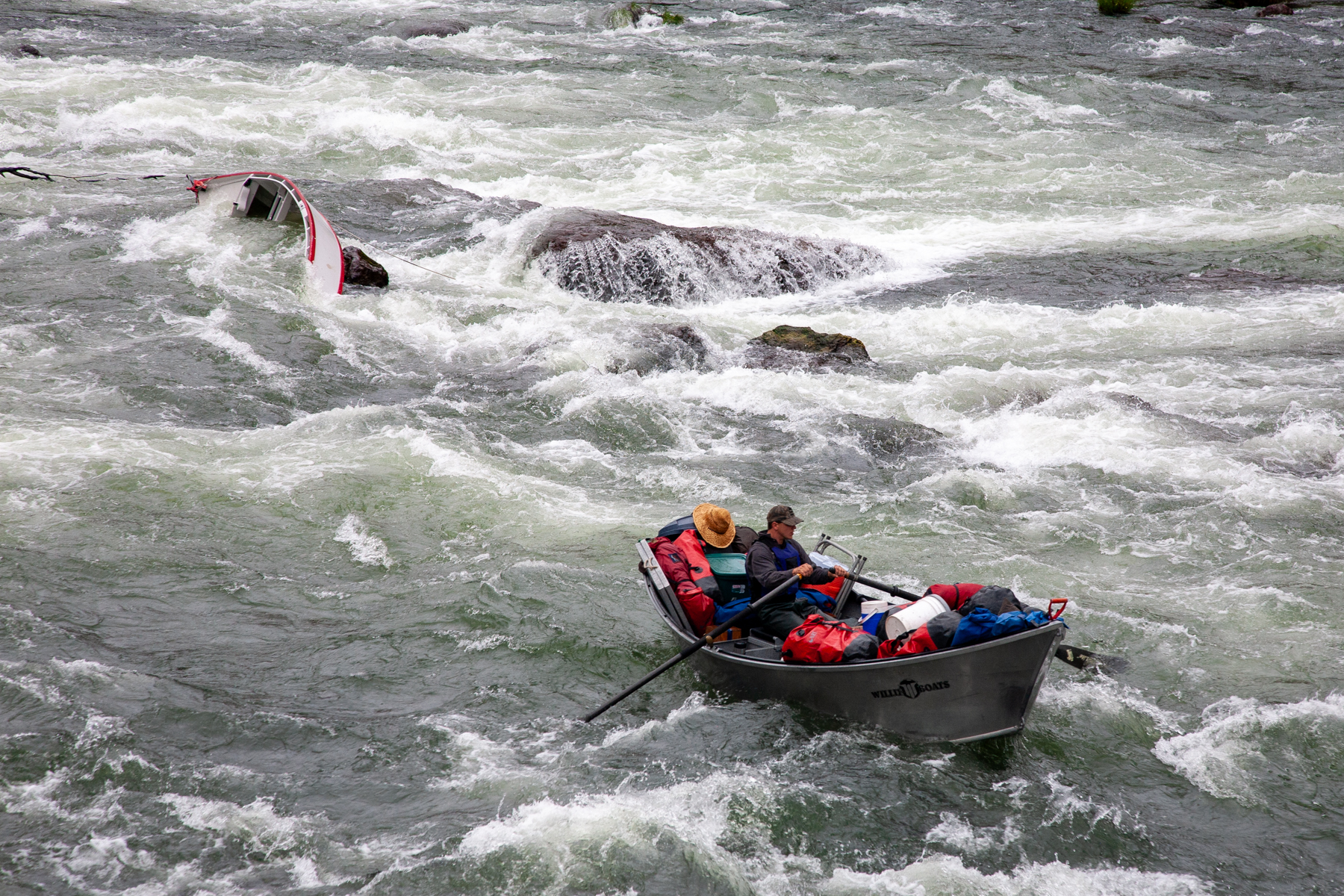
We drifted down through a bright, swift channel between wooded islands and spotted our boys fishing through the long run at Bed Springs. The sun was maybe an hour out from hitting the water. Just then the radio on my chest chirped to life. It was Gordy, asking if we were at Kloan yet. “There’s a support raft coming down just ahead of me, said he was heading for Kloan; he’s humping, too.”
“Shit.” I figured I had ten minutes, max. I ferried closer in toward shore within shouting distance of the boys, caught the oars under my knees and held out both arms, palms up. Don put a single finger into the air and Mike shook his head. I nodded. “Okay,” I called out, “here’s the deal. There’s a boat just behind us heading for Kloan and we’re going to beat him to it. If you want to keep fishing, no problem. Hike down up on the grade when you’re done and I’ll row across and get you when you reach camp. Or I can take you down now.”
They looked at each other and turned back to me and said, in unison: “We’re good!” I laughed, looking at Ken. “What about you?” “All ashore,” he said, laughing. On a long straight stretch of water I catch a glimpse of a raft pushing hard down river, but still far behind. Sure enough, I reach Sumac Camp and plant my flag just as another party is pulling out. A very good day, indeed.
***
The fishing continues with the Deschutes Journals, Part Three. Hooked? Catch the crew’s prior adventures—and more of Rob’s fishing wisdom— in the Deschutes Journals, Part One.
Photography courtesy of Rob Lyon, Ken Morrish, Ben Herndon, Mac Holt, Arian Stevens and Zento Slinger.