As guides, most of our mileage, sights, and experiences were dictated by clients’ wishes and bucket list items. We closely scanned the waterline for silhouettes of sea otters, harbor seals, and various other charismatic animals. We’d toe the line between adventure and hazard, getting clients as close to the calving glacier as everyone’s safety would allow. Thus far on our trip up the Columbia River, we’ve seen a variety of creatures and critters, including sea lions, baby turtles, raccoons, and the occasional fish jumping out of the water.
But this summer, our focus has shifted. Instead of hunting out the best chance to see a pinky leap out of the water, we became focused on the aspects of their journey we had previously overlooked. Not the picturesque humpback whale surfacing and spouting, but paddling through wing dams, dodging hunks of sheet metal from rusted boats, and carefully following the main channel to avoid becoming stranded in the algal blooms of the Columbia Slough.
Instead of guiding clients through towering fjords, we are journeying up the Columbia and Snake rivers, letting the salmon be our guides and learning from them how to navigate the waters of their terminal migration upstream.
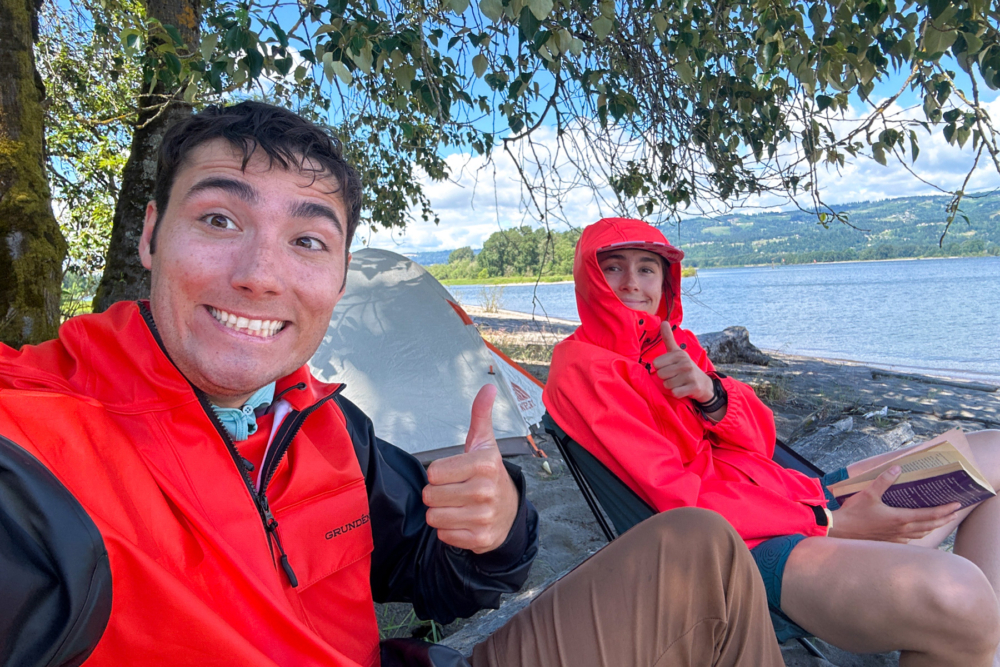
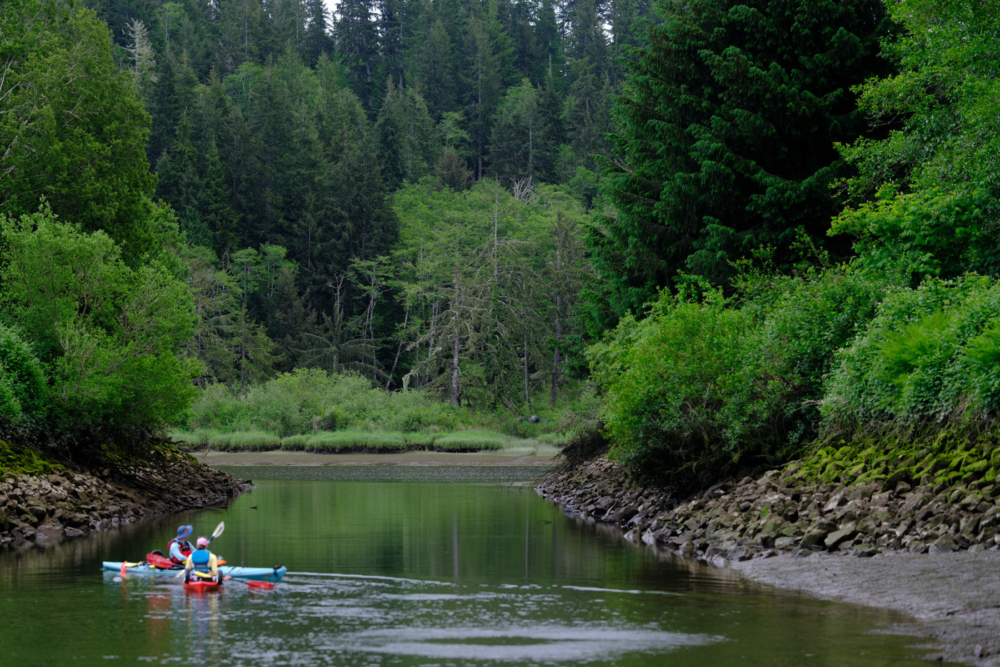
In roughly the first 30 miles of the river, we made a couple foolish decisions. The main one being: we paddled in the middle of the channel, unknowingly battling much higher current and winds. To clarify, we were not paddling in a shipping lane, but tucked into an estuary where neither ships nor large vessels go. We heard not the sound of boat traffic, but the soft hiss of reed grass bending in the eastward breeze.
After paddling through the tranquil estuary for a little while, with all its twists, turns, islands, and sand bars, we relaxed into the motion of it all. We made crossings from island to mainland, breaking away from the shore due to various strainers which were mostly downed trees. We took a lax approach, trying to cut corners around river bends until we left the estuary (but still not in the main shipping channel).
Further upriver, the current against us was far stronger. As we marked our snail’s-pace progress, we continued the habit we’d developed in the estuary, cutting across the river when it appeared to shorten our route. Whether by illusion or reality, whenever we drifted close to shore, our speed seemed to increase dramatically. From there we island hopped, remaining well away from the wing dams on the Oregon side of the river.
Due to the current and ebbing tide, four hours into paddling we had hardly moved, but having chosen to paddle our way upriver rather than drift down it, we had already resigned ourselves to the Sisyphean slog. Albert Camus famously wrote, “One must imagine Sisyphus happy.” With sweat running down our foreheads, carrying sunscreen and salt into our eyes where it burned like hot chili oil, we began to understand why: after millennia of uphill climbing, Sisyphus was probably jacked.
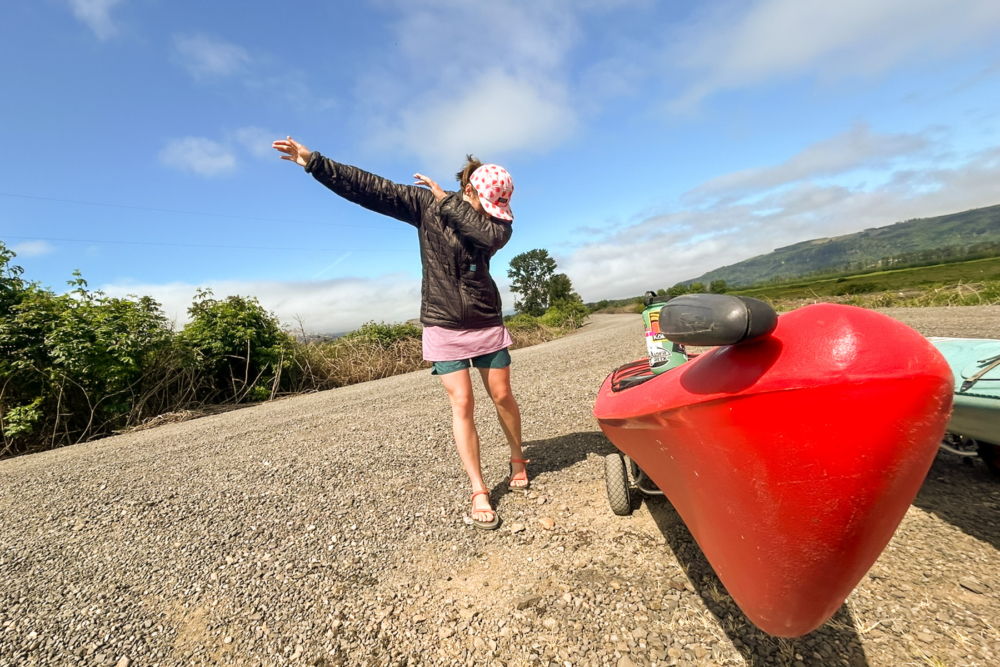
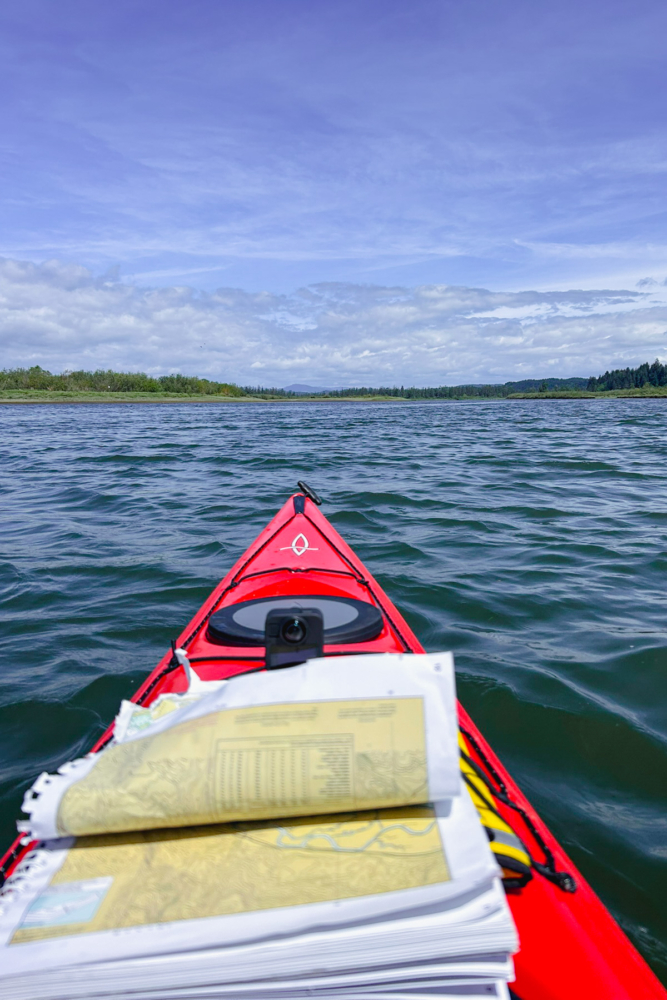
While we both love a good slog and pushing our bodies to the limit (we’re both into sea kayaking and mountaineering), it was too early in the trip to be making such slow progress. We had to try something new.
Looking at Oregon’s shoreline, we were nervous that the wing dams would greatly increase the distance we needed to paddle, taxing our bodies each time we would have to pass around them. But we didn’t have any other options, and the only salmon we’d seen thus far had its head bitten completely off—not necessarily a good omen for the route we were traveling.
We decided to make the crossing to the Oregon side, our Nalgenes full of instant coffee for the next major push of the day. As we stayed closer to shore, we realized we could use these wing dams as a kind of quasi-fish ladder: holding 20 or 30 feet off shore until reaching one, then ferrying out into the channel, slipping around its outer post, and leaping back into the slower water behind it.
This slower water behind the dams encourages sediment to drop at the sides of the Columbia so the shipping lanes stay deep enough for the large barges. As we paddled feature to feature, our pace increased to around three miles per hour, and salmon were jumping out of the water next to us—a much better omen than the first salmon we encountered.
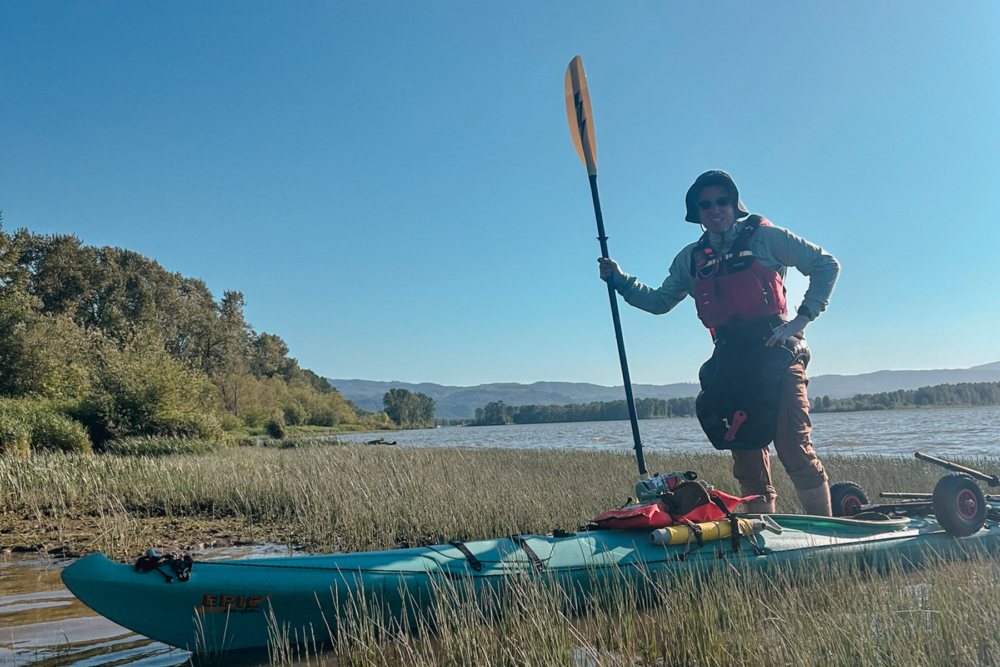
Yet as we passed them, we began to notice the wing dams’ states of disrepair. Many consisted of partially detached creosote-soaked timbers that undulated from side to side, clanking against one another with each surge of current. Some of the outer posts were missing the pylons used to alert boaters of the wing dam, which sink just below the surface at high tide. Occasionally, we’d see evidence of calamity: the remains of boats from previous wrecks sloshed against the pylons.
These wrecks were never cleaned, nor were the wing dams repaired. But that didn’t stop some sea lions from hanging out below them to try and catch fish. Nor did it stop the ospreys, which perched atop the outer posts in marvelous wicker-basket nests. Every time we passed, one or two birds launched skyward, whistling sharply as if to say: don’t you dare come any closer. Several dove hard toward our boats before veering upward at the last moment.
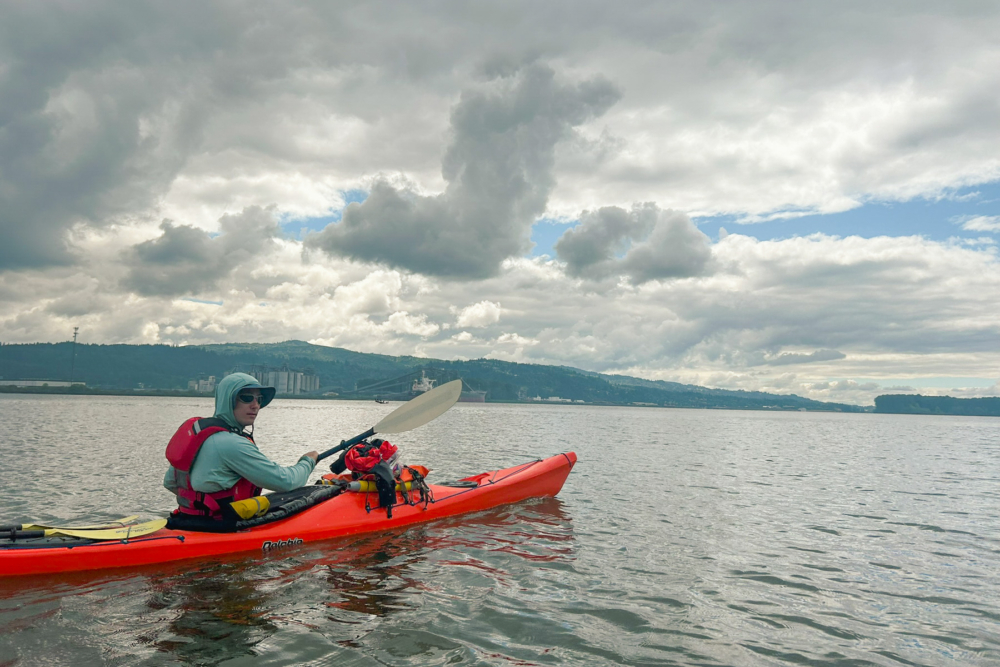
Just past Rainier, Oregon, the wing dams became few and far between. We would occasionally get batches of them, protecting an island or marina from erosion, but not nearly as prevalent as before. From there, our strategy changed. Straying out too far into the channel would push us into conditions that had more current, wind, swell, and white-capping water. We needed to stay closer to shore for those reasons, but we decided to take some lessons from the salmon and use the eddy systems (though we are experienced sea kayakers, neither of us knew how to read a river).
These eddies propelled us forward, making the upstream slog considerably easier. Salmon, too, exploit these same slackwater eddies on their upstream climb. Like us, they move not by brute force alone, but by reading the river and slipping through its softer seams.
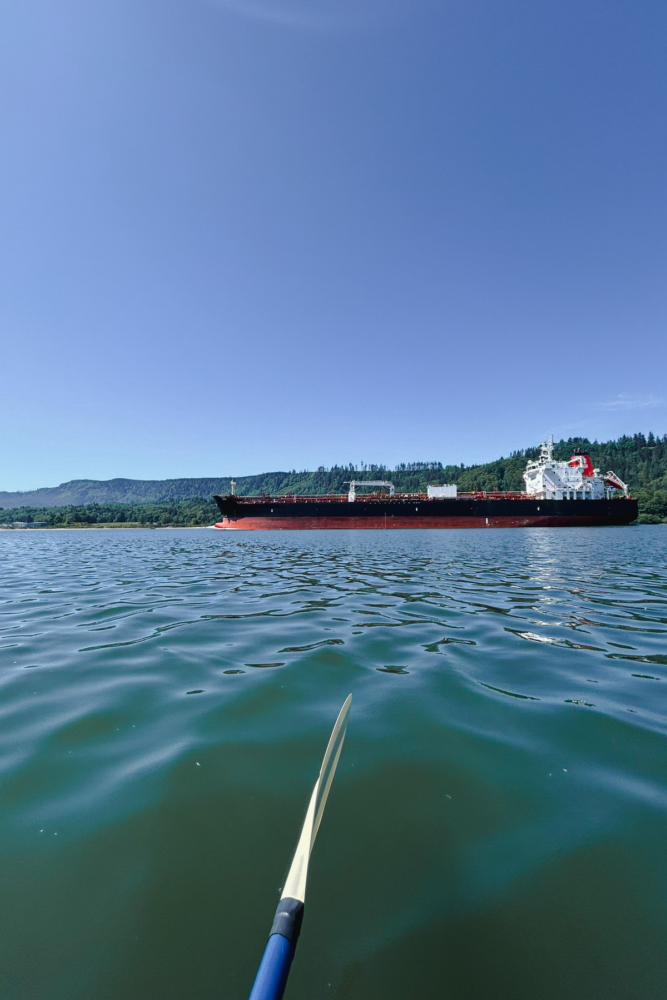
As we paddled further upstream, we noticed paper mills and chemical plants rising from the water’s edge like metal leviathans, their conveyor arms reaching into the channel to receive container ships, barges, and tugs. Lacking any real understanding of what happened inside those colossal machines, or who kept them running, it was easy to fall into an old mariner’s instinct: thar be monsters.
Occasionally we passed the ghosts of industry past: abandoned salmon canneries, rusted frameworks unmoored from any visible purpose, burned-out houseboats slowly surrendering to the current, and electrical wires slithering into the murky depths. Yet even here, life had adapted to the wreckage. Swallows nested beneath conveyor rails, seals hauled themselves onto abandoned concrete docks, and cattle grazed the neglected margins of chemical plants. Like the wing dams, these structures had become unlikely habitats, folded back into the river’s ecology.
What ultimately commanded our attention, however, was the smell. At first it drifted faintly on the wind, then settled around us in heavy drafts: steamed broccoli and sulfur. The paper mills that remain the economic lifeblood of the lower Columbia release sulfurous compounds as wood is broken down into pulp, and their odor hangs over the river for miles.
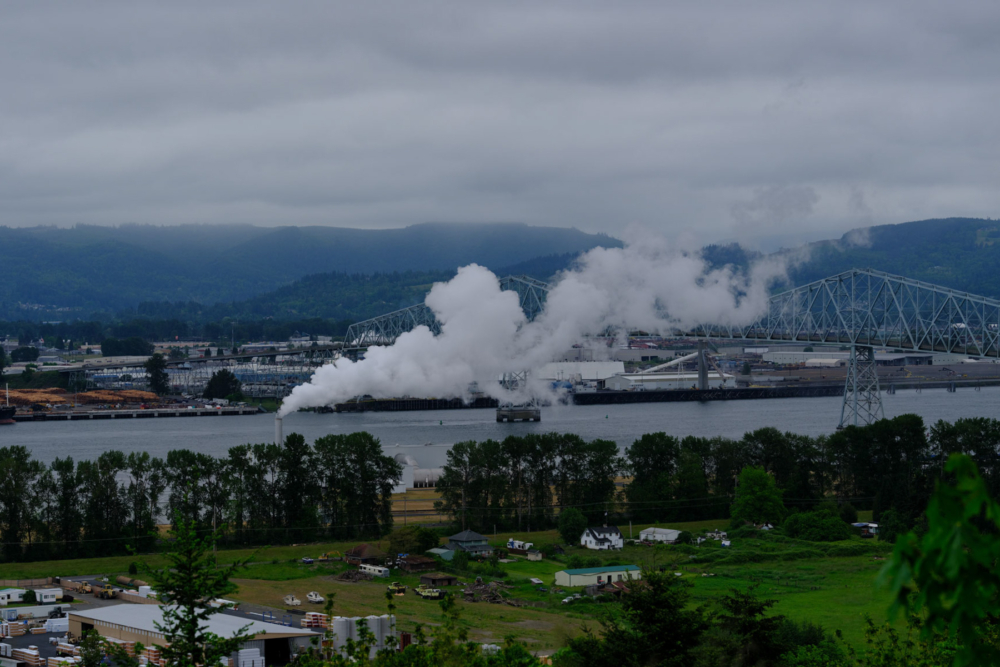
If we could smell it from our kayaks, surely the salmon could too. Salmon navigate home by scent, following the particular chemical signature of their natal streams with astonishing precision. They smell their way back across hundreds of miles of ocean and river, tracing invisible gradients toward the gravel beds where they were born. Paddling beneath smokestacks and through that sulfurous haze, we couldn’t help but wonder what the river smells like to them now.
That question became less abstract one afternoon when we turned on Oregon Public Broadcasting. That morning, across from Rainier, a white-liquor tank imploded at the Nippon Dynawave paper mill, killing eleven people and sending 550,000 gallons of caustic chemicals into the web of sloughs and drainage channels that flow toward the Columbia. In the days that followed, response crews recovered nearly 2,000 dead fish from those waters.
But even with all the figures given, we found it hard not to think about what escapes measurement. Salmon navigate by gradients too faint for us to perceive, tracing homeward routes through molecular signatures dissolved in moving water. Their migration depends upon a chemistry so subtle that each tributary carries its own olfactory fingerprint. For us, the lower Columbia announced itself through the blunt odors of industry: sulfur, steam, pulp, diesel. To a salmon, the river must be infinitely more articulate, every current carrying information.
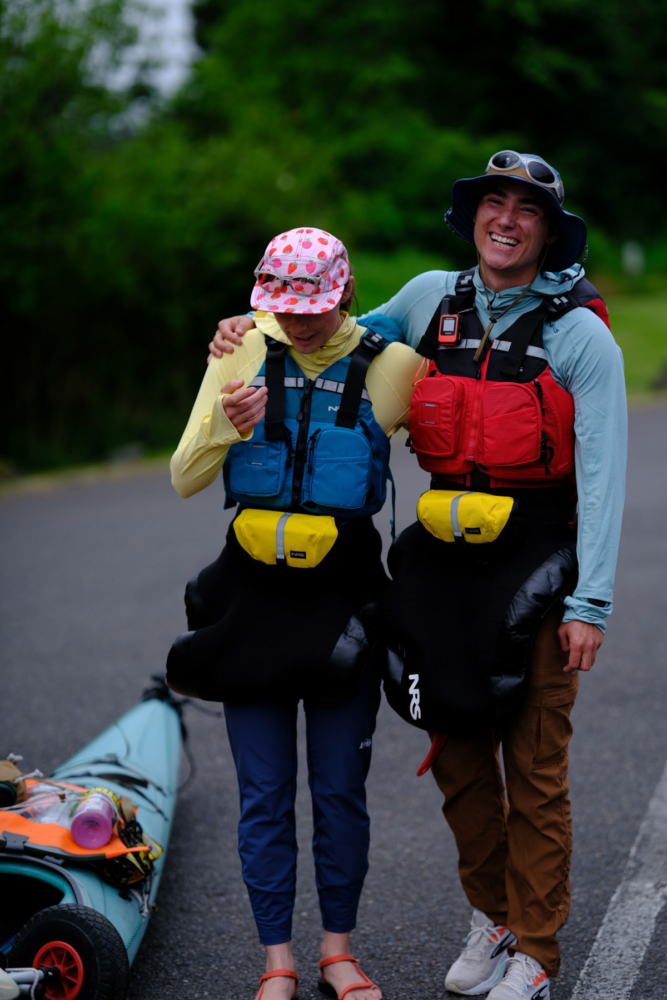
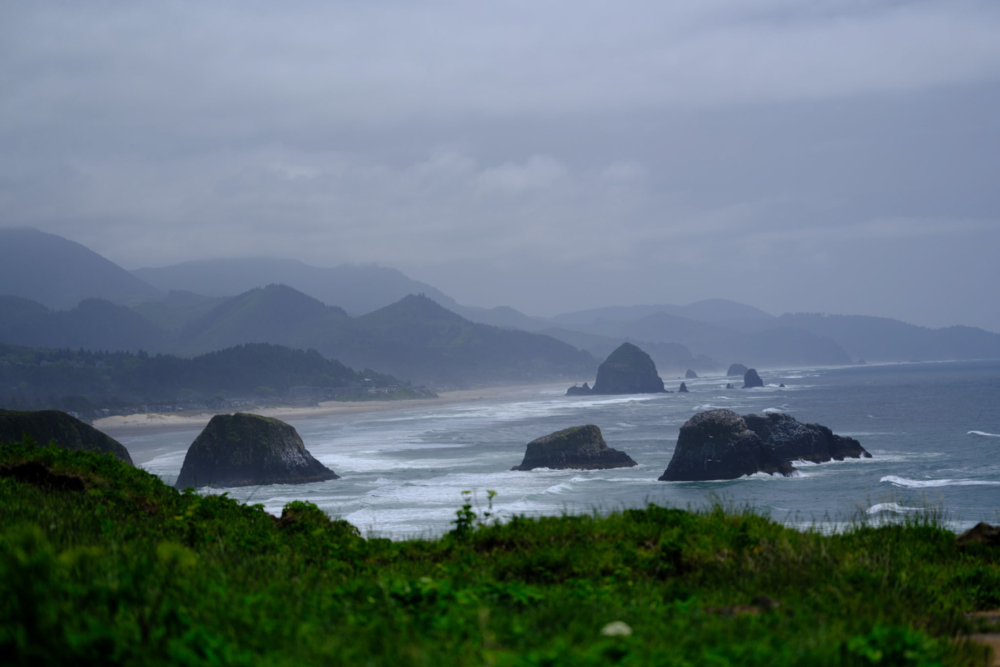
We spent those days learning to read the Columbia by watching its surface: the bend of grass in the wind, the glassy seam behind a wing dam, the slow back-eddy curling against a post. We began the trip hoping to follow salmon upstream. Along the way, they taught us to read a river differently. The lesson was not simply where to paddle, but how much of the river exists beyond our own perception. To travel with salmon, even imperfectly, is to recognize that the Columbia is more than a route, a playground, or a backdrop. It is a homecoming corridor for countless lives moving through it.
The salmon read something deeper, following a map written in scent. A river can absorb remarkable insult and still keep moving seaward. It can carry our waste, our wreckage, our pilings and smokestacks, and still appear stable from a distance. But for creatures that know home by smell, endurance is not the same thing as invulnerability. Long before we register alarm, the river has already changed. The Columbia keeps flowing. The salmon keep searching. The question is, when they return, will home still smell like home?
***
Guest contributor Eddie Newsom is a senior environmental studies major at Reed College and a summertime kayak guide. He started paddling at age 18 when he first started guiding in the Kodiak Archipelago, an island filled with bears, puffins, salmon, and memories. He returned up north for subsequent summers, kayaking the glacial fjords of Prince William Sound. When he’s not on the water, he loves climbing volcanos, pickin’ banjo, and organizing trips for his college’s outing club. As an avid flip-phone user, you can’t follow him on social media, but if you’re lookin’ for him, he’ll be on the river!
–
Guest contributor Caroline Menten is a senior English literature major and environmental humanities minor at Reed College. She grew up in Northern Colorado and spent most of her time in the foothills and mountains of the Rockies. Once she got to college, she got hooked on sea kayaking, and soon became a sea kayak guide in Prince William Sound, Alaska. She loves to explore the trails, climbs, and paddles of the Pacific Northwest whenever she doesn’t have her nose deep in a book. But sometimes Amitav Ghosh is best read from a tent!
Editor’s Note: To learn more about Caroline, Eddie, and why they’re paddling upstream on the Columbia and Snake Rivers, read: So, What Are You Doing This Summer?
You can follow their journey at returningagainsthecurrent.com.